While building some IKEA furniture the other day, I decided to listen to a podcast by two brilliant authors (Victoria Aveyard and Soman Chainani) about the topic of AI in publishing and writing.
I have seen many authors and writers on the internet have varying opinions of AI, and being someone who writes, and enjoys the challenges of it – I wanted to research what actually were the issues with artificial intelligence being used to write books? Is it successful? Is there a future where authors truly are pushed to the side for fast-tracked published novels that hold little literary merit and originality? Can a regular reader distinguish between AI material and something written by the hand of a human?
The idea of creativity is something that has always intrigued me. I describe myself as a creative person, even outside my writing. I grew up dancing, have a love (though unfortunately varying degrees of talent) for art; photography, videography, editing; I find them all enjoyable and requiring of creative, original thought. However, after listening to the Plot Twist Pod, I decided to have a little Google search myself, and run a little investigation on my family and friends.
So. Artificial Intelligence. The Enemy. I think it’s vital to say that I did approach this research from a biased persepctive. AI is integrating itself into our society, and I hate how readily it is used, sometimes without my consent (Google’s AI answers to my searches). I also hate the idea that something so prevalent to society and humanity, some would argue the pinnacle of our continued survival and existence — storytelling — is being created by a robot with no understanding of the complexity of life that humans continuously experience.
First things first, I read a variety of articles from a variety of sources. If my time at university taught me anything, it is that you have to have a minimum of 10 sources for every essay.
What I found was mostly inline with my expectations. Artificial Intelligence is being used by many companies, and unfortunately writers too. AI platforms such as ChatGPT are based on language learning models that vary in depth – but ultimately, they learn through evidence that is made available to them. ChatGPT itself has learnt from a database that is roughly 570 GB which includes books, Wikipedia articles, web pages, research articles, and many other sources. In total, approximately 300 billion words went into its database. That’s a lot of words, and it made me wonder, how many of these words were novels that were fed into the database?
Shockingly, I found out that published authors are having their texts, their writing be used to train AI. Without their consent. Without the authors seeing a penny for their hard work.
As someone who has worked their butt off for the last five years to write and revise a book, I can’t imagine how it must feel for those who have trusted the world with their books, and make a livelihood from them, for the work to be pirated and stripped away from them, to train up robots to produce literature at a faster rate than humans could write. Unless your Brandon Sanderson, but we’re not talking about the insane amount of books he publishes at a time. I’m pretty sure that man is a machine himself. Interestingly, in his author note for Wind and Truth, Brandon clarifies that all the words are written by him. Whether that is a slight towards AI, or critics saying Brandon doesn’t write his own work…who knows.
But to think that these talented, creative individuals who work hard to bring worlds, characters and stories to life are being used to train AI platforms to eventually do their jobs for them? They’ll eventually be fighting their own reflections! Grr.
Unfortunately, there is still no legislation to protect these authors from their work being used in this way. The Author’s Guild believe that authors should be able to choose whether they want their work to be used by AI, and be able to set the terms for this use. The fact that this is not the standard is insane. I understand that when traditionally publishing a book, you relinquish some control over it, but that work is still copyrighted to you, and shouldn’t be used in secret, against you.
So, with the frustration and annoyance at the dependancy that we have on ChatGPT and AI, I decided to run my own little experiment. I used an extract from my own writing, Bug Beauty, and asked ChatGPT to write a story based on it. Here is what it gave me.
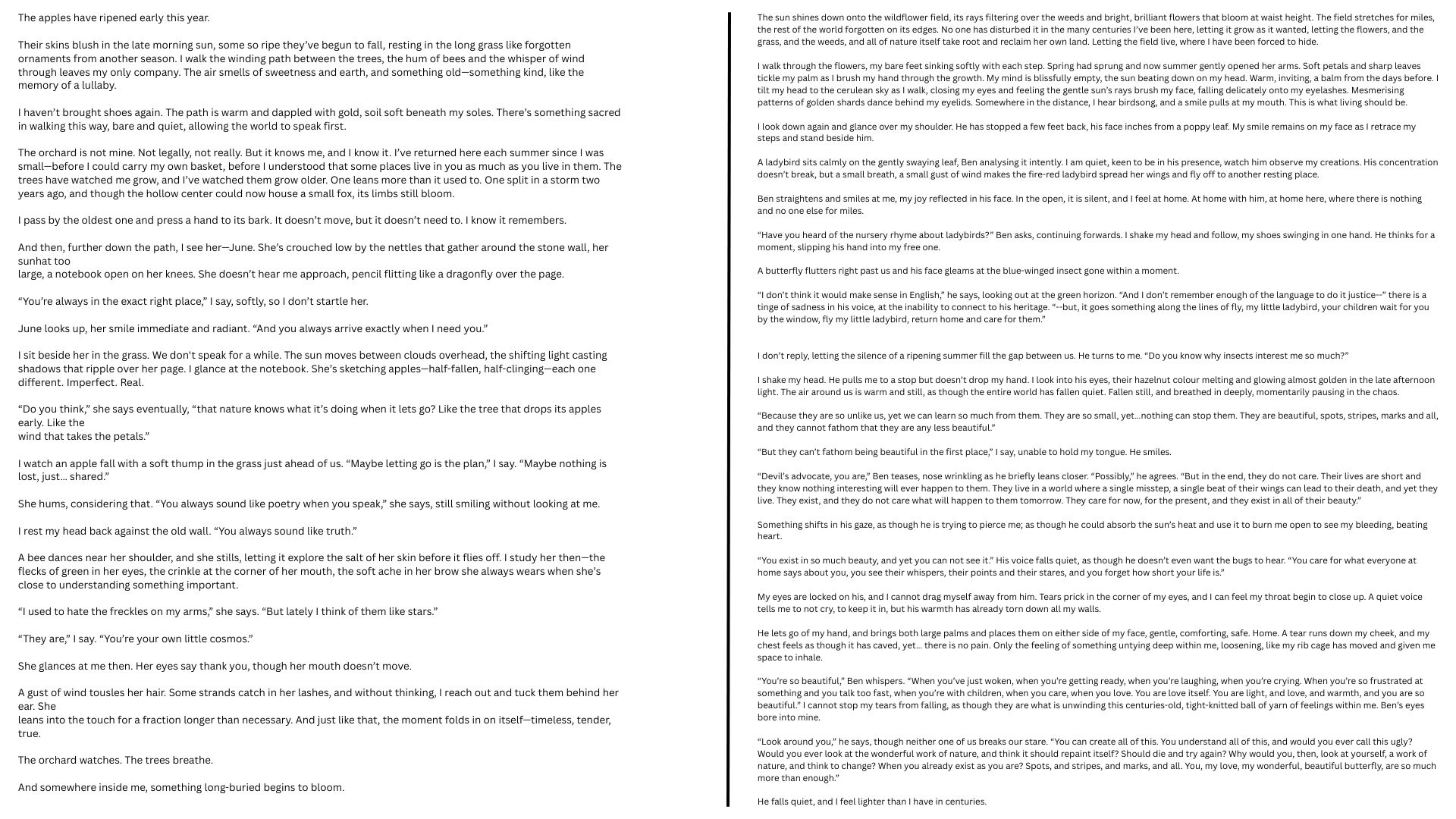
Reader, before we continue: give yourself a few minutes, which do you think was written by AI, which by me? I confess, when I ran this small experiment on a few others, there were some small dead giveaways that with a run-through I would have caught and fixed.
Now, unfortunately, since I ran this little project, the conversation I had with ChatGPT has been deleted, as I was away for a few weeks on holiday, and I didn’t save it, foolishly thinking it would still be there upon my return. Alas, we continue. Firstly ChatGPT praised the hell out of my work. Quite a glowing review, all about its prose and elegance, its warmth and subtlety. If I’m honest, very kiss-assy to me. As much as I love how brilliant I am, it did make me a little uncomfortable coming from a programme that speaks in 1s and 0s.
It then delivered its own piece of work that was very similar to mine. Almost too similar. I had a quick conversation with it about where it gets its language learning models from. All public domain, it says. I continued digging, until I found that it had used authors who are still alive and whose work is not in the public domain to help write the story, such as RF Kuang. Cool.
I asked it to forget my story, and to ignore influences from authors dead or alive and to write me a story based on an orchard. In hindsight, is my methodology the most scientifically accurate? Probably not. It then came out with the piece I shared above.
I sent both pieces, both anonymised, around to a few groups, to see if they could discern which was mine, which was AI.
- My Masters classmates, all very talented writers. High expectations from them.
- My family. Not regular readers, English as a second language to most of them, but fluent in English and have read my work before. As their daughter/sister/wife, again high hopes.
- My friends on my Instagram – varying levels of readership and use of AI.
And brother, where the results interesting.
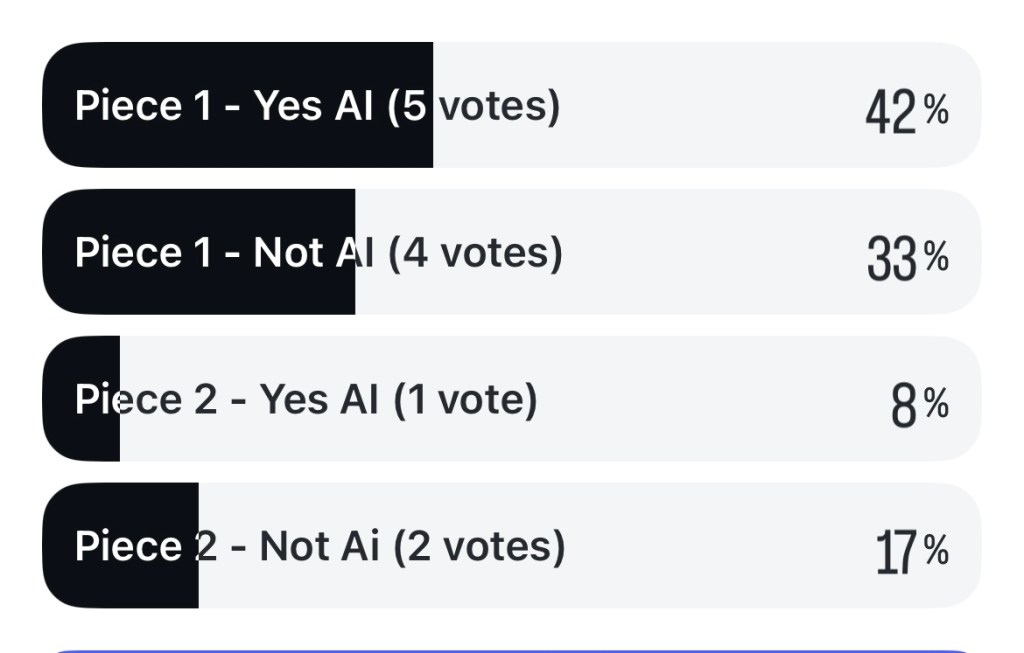
From the screenshot above, you can see that people were quite evenly divided over whether the first piece was AI or not. People were a lot less certain about the second piece, maybe they thought that if they voted for one, their answer was clear for the second? Either way, AI had managed to fool, or at least cause people to be unsure on whether the excerpt was written by a robot or by me, a human with a degree in creative writing.
(We’re going to ignore the fact that people might think my writing robotic… I’m not going down that rabbit hole!)
I can’t say I was surprised. After all, even I was surprised with what AI was able to generate. So, I decided to take it one step further. I ran the AI text through five different AI and plagiarism checkers. I didn’t expect it to flag for plagiarism, as it wasn’t word for word copied from my extract, but I was expecting these “best AI checkers” to flag that this was entirely written by a bot.
One did.
Out of five.
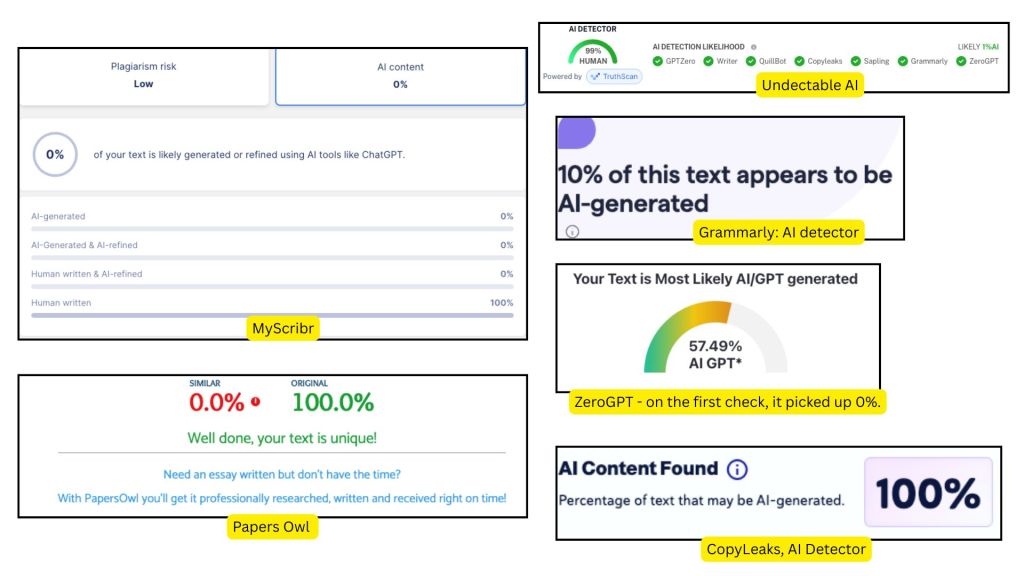
Some of the programs were used by universities, to help check academic essays. Isn’t it so brilliant? We are training AI so well, that even other AI can’t pick it out! What hope is there for the original and independent thought if our academia is slowly replaced by articles half-written by AI?
And then, of course, there are those sites and programs that sell essays to students. I won’t even get started on how I feel about this level of plagiarism and cheating, regardless of it being written and sold by humans or AI.
As I was doing my own research into this, I did have to swallow my pride a bit. There were some programs that were based on artificial intelligence, that actually seemed helpful for academics. Summarising long articles so that researches and professionals can use their time more efficiently. Another paper I read, asked real published authors to use an AI program to help write their stories for eight weeks. Most of them were excited and pleased with it being a toolbox, a place to generate ideas where the author can then bounce off of, a thesaurus etc. And I can’t continue without admitting, that yes, I have used ChatGPT to find me a synonym, or to explain a historical piece of clothing that I couldn’t figure out.
But, with all that said, I have a fear that our dependance on AI and ChatGPT for the simple tasks, will make us dependant on it for our own individial thought. What I love about writing, is how it forces me to face myself. I have to think of the right metaphors and images to portray the feeling I want to, to my reader. A robot who doesn’t understand human emotions won’t be able to do that effectively. As a teacher, I drill into my students heads: what is the purpose of your written work, and how can you achieve it? How can you make your audience scared, excited, persuaded? How can you make them cry over a death of a fictional character?
And though ChatGPT delivered a well-written short story set in an orchard, a few of my readers mentioned that it was lacking something. My mum purposefully chose the word “soul”. It lacked a depth. If our litereature becomes written by the AI Authors, then the quality of our literature will decline. Empathy, socialisation will decline. Don’t get me started on the research that is out there for why reading is so important to a persons emotional and social development. If our children and the generations ahead grow up learning to emote not from people living lives and sharing it through story, but through robots emulating it with no soul, how then can we expect them to do better?
Penguin Random House put it beautifully in response to the Government’s consultation on AI.
We write from a position of belief that creativity and innovation are not in opposition to one another but rather connected and complementary.
I think that’s it, isn’t it? We live in a world of increasingly fast-paced innovation. It’s incredible the things that science and the creative minds of academics can achieve. But it’s important that we don’t let go of the things that make us human. To think for ourselves and have our own opinions. To experience life and retell it in a way that takes our audience through the experience with us. To tell stories and pass them on through generation to generation.
I believe AI can have a place in the writing world. Use it as a toolbox. Use it to find that word that you just seemingly can’t remember, or to find a more succint phrase. But don’t allow it to become the one who feeds our creative wells. It doesn’t, and I hope will never, have the soul or capacity to do so. A programme will never be able to understand humanity, no matter how developed it gets. In the same way that we will never know what it is to be a tree, no matter how much we try to emulate its life.

I could go on and on about this topic. It’s interesting. Since I first listened to that podcast, I can’t help but notice how AI is absolutely everywhere. Even while writing this: I want to add a picture? Generate with AI.
Sources
https://authorsguild.org/news/ai-licensing-for-authors-who-owns-the-rights-and-whats-a-fair-split/
https://www.thehoth.com/blog/ai-vs-human-writers/
https://www.junia.ai/blog/ai-vs-human-writers
https://www.penguin.co.uk/about/company-articles/response-to-consultation-copyright-and-ai
The Influence of Artificial Intelligence on Creative
Writing: Exploring the Synergy between AI and Creative
Authorship – Ljubinko Stojanović et al. https://www.researchgate.net/profile/Vesna-Radojcic-2/publication/376478785_The_Influence_of_Artificial_Intelligence_on_Creative_Writing_Exploring_the_Synergy_between_AI_and_Creative_Authorship/links/657ab04eea5f7f02056d6485/The-Influence-of-Artificial-Intelligence-on-Creative-Writing-Exploring-the-Synergy-between-AI-and-Creative-Authorship.pdf
Creative Writing with an AI-Powered Writing Assistant:
Perspectives from Professional Writers – Daphne Ippolito et al. https://arxiv.org/pdf/2211.05030
 Ruta Grainyte
Leave a comment